URI PhD student shares coastal groundwater research at a national conference with support from a Rhode Island Sea Grant travel scholarship.
Sea-level rise can threaten roads, buildings, and buried infrastructure in often invisible ways.
Rising coastal waters push saltwater into groundwater systems, creating risks that are less visible than coastal flooding, according to University of Rhode Island PhD student Md Al Amin. Using groundwater models of Warren, Rhode Island, Al Amin is investigating how urban infrastructure accelerates these risks and why a coastal town may respond differently from a rural landscape.
Warren, a small coastal town on the eastern shore of upper Narragansett Bay, already experiences tidal flooding on streets and in public spaces. The town is also the focus of a broader URI research and outreach effort to understand flooding risks and community priorities, with Rhode Island Sea Grant supporting community engagement.
Al Amin’s research examines the less visible changes occurring beneath the town, with the aim of developing models useful to
other low-lying coastal communities. Urban development, including paved surfaces, buried
infrastructure, and drainage systems, alters natural groundwater flow and potentially increases the vulnerability of coastal communities, he explained
Below: An aerial view of Belcher Cove in Warren showing high water levels.
Groundwater rise and associated flooding are often invisible and difficult to predict because groundwater can move beneath the ground surface and bypass barriers designed to protect communities from surface flooding.
His research focuses on how urban infrastructure, especially aging storm and sewer drainage systems, may influence saltwater movement underground. He hypothesized that this infrastructure could provide additional pathways for saltwater intrusion, contributing to differences in how urban and rural areas respond to rising seas.
To investigate these differences, Al Amin developed models that simulate how groundwater moves and how freshwater and saltwater mix beneath Warren. These simulations could help researchers better understand how coastal groundwater responds to sea-level rise and identify risks that might be overlooked.
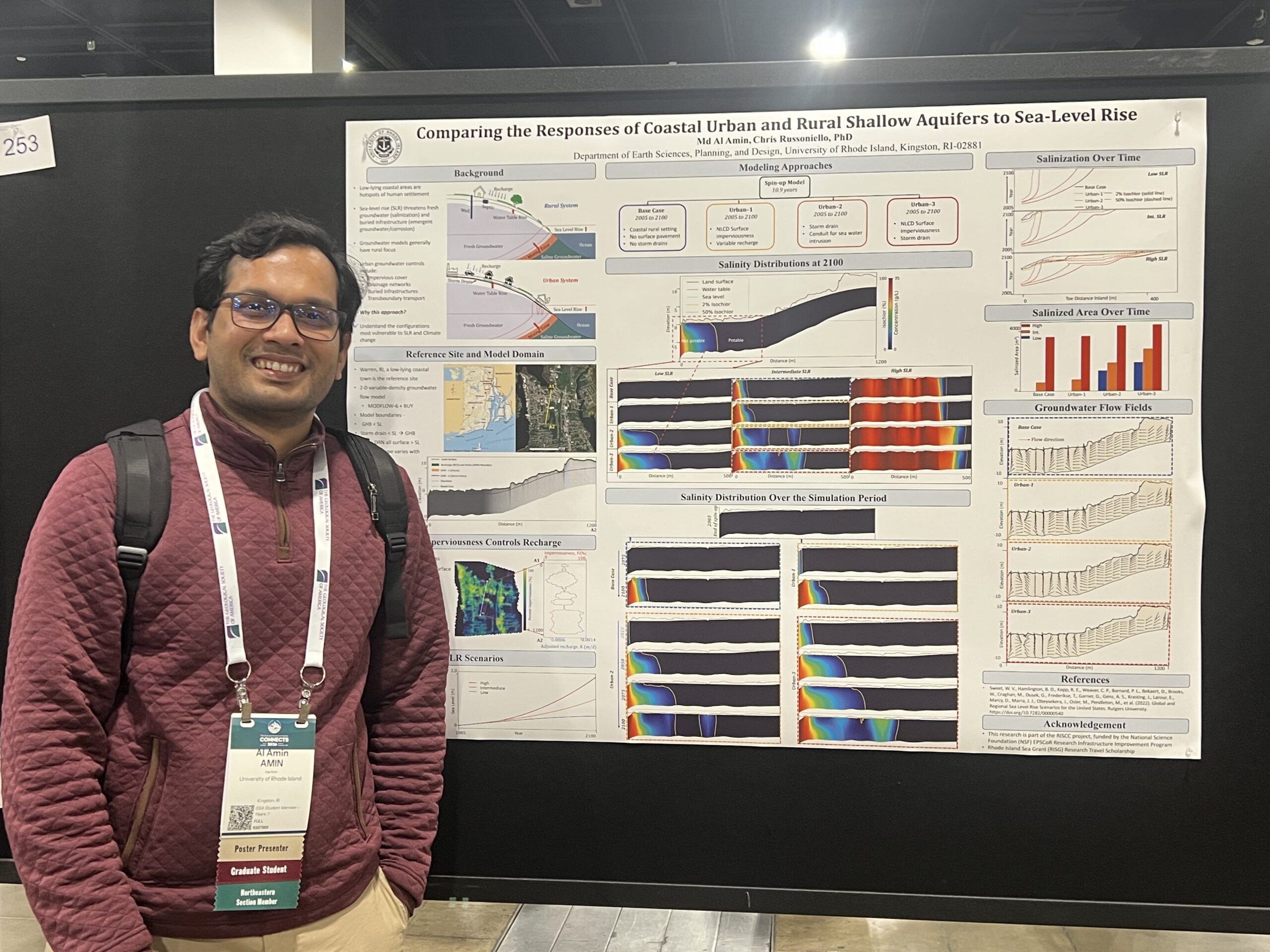
With support from Rhode Island Sea Grant’s Research Travel Scholarship, Al Amin recently presented his research at the Geological Society of America (GSA) Connects 2026 conference in Denver, Colorado. Conversations with fellow geoscientists offered suggestions to strengthen and expand his models.
Norman S. Levine, director of a Center of Excellence in Geographic Information Systems (GIS) and Remote Sensing at the College of Charleston, South Carolina, suggested incorporating storm surges.
“This was a helpful suggestion for expanding my research to better understand compound coastal flooding hazards,” said Amin. “This was a helpful suggestion for expanding my research to better understand compound coastal flooding hazards.”
Amin now plans to validate his groundwater model of Warren and prepare his findings for publication in a peer-reviewed scientific journal. He credited the travel scholarship with making his conference participation possible.
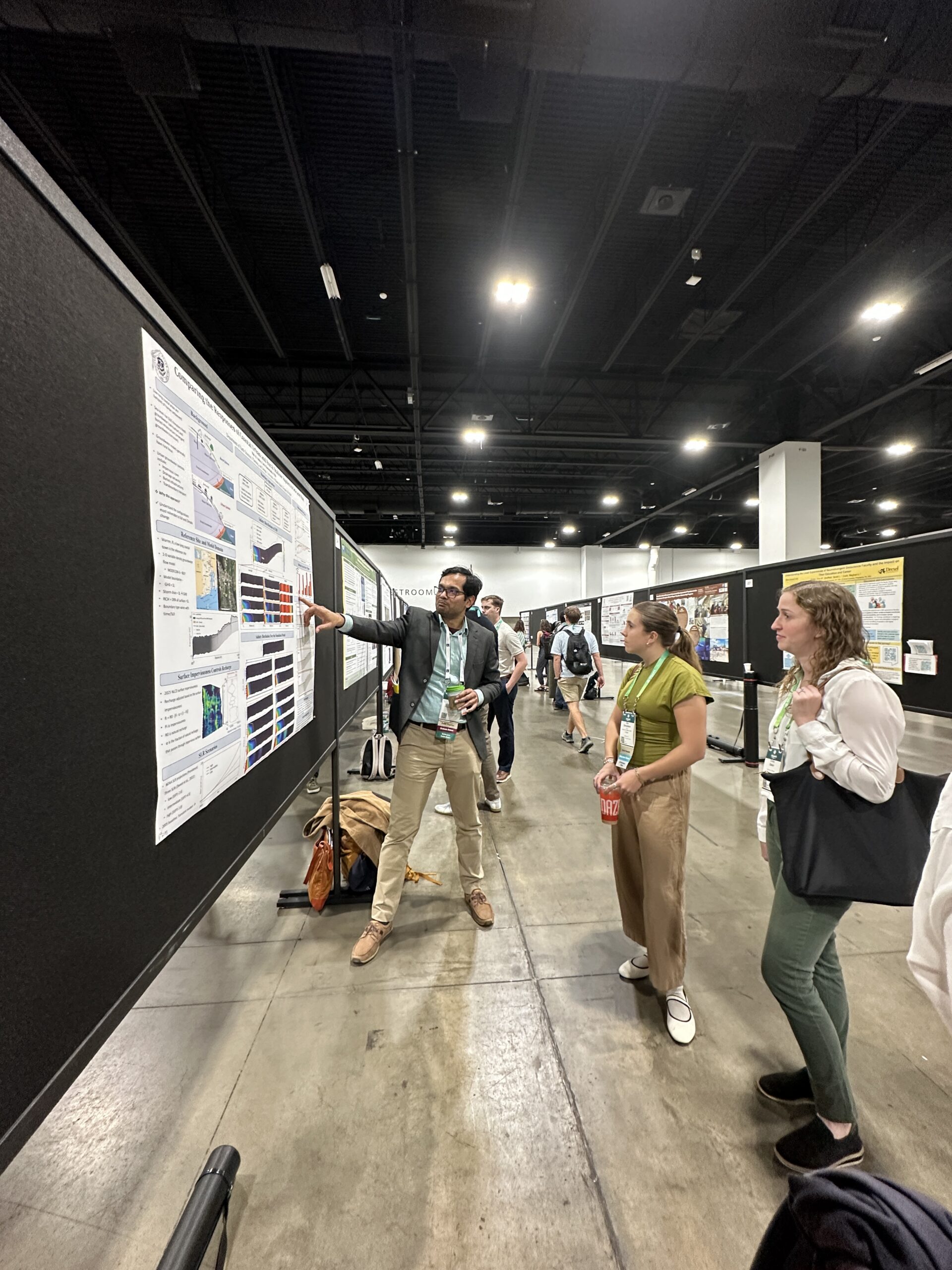
University of Rhode Island PhD student Md Al Amin discusses his coastal groundwater research at GSA Connects 2026 in Denver. Photo by Samiul Alim.
“The knowledge, ideas, and professional connections I gained will help strengthen my ongoing research and contribute to a better understanding of groundwater-related hazards facing Rhode Island’s coastal communities,” he said. “These opportunities would have been much more difficult to pursue without the support of this travel award.”
By helping students like Amin bring their research to a broader scientific community, Rhode Island Sea Grant creates opportunities to exchange ideas, build collaborations, and strengthen work that informs coastal communities’ responses to environmental challenges.
Related story: A Community Walk Through Warren’s Resilience Efforts
About the Research Travel Scholarships
Rhode Island Sea Grant’s Research Travel Scholarships offer URI undergraduate and graduate students up to $2,000 toward eligible expenses to present their work at professional meetings and conferences.
Funding for the 2026–2027 award cycle has been fully allocated.
For more information about the Research Travel Scholarships, contact Kim Ohnemus at kohnemus@uri.edu
By Hadassah Rigby, Rhode Island Sea Grant Science Communications and Digital Media intern