
As coastal storms become more frequent and complex, accurately communicating evolving hazards is critical to public safety. But the information emergency managers rely on to prepare for a storm isn’t always the same information journalists need to explain risk to the public.
Those questions brought together journalists, emergency management professionals, researchers, and Rhode Island Sea Grant for a recent workshop hosted in partnership with the Metcalf Institute.
Participants worked through hands-on exercises using [Coastal Hazards, Analysis, Modeling, and Prediction (CHAMP)] system. They explored how storm information is interpreted and communicated—and ultimately how it can support preparedness before a storm makes landfall.
“The media, particularly local media, are often the primary way that communities hear about impending storms and what to do as they approach,” said Fara Warner, executive director of the Metcalf Institute. “Often journalists are only meeting emergency managers during and after the storm, but this immersion really helped our journalists understand what goes into predicting the impact of storms.”
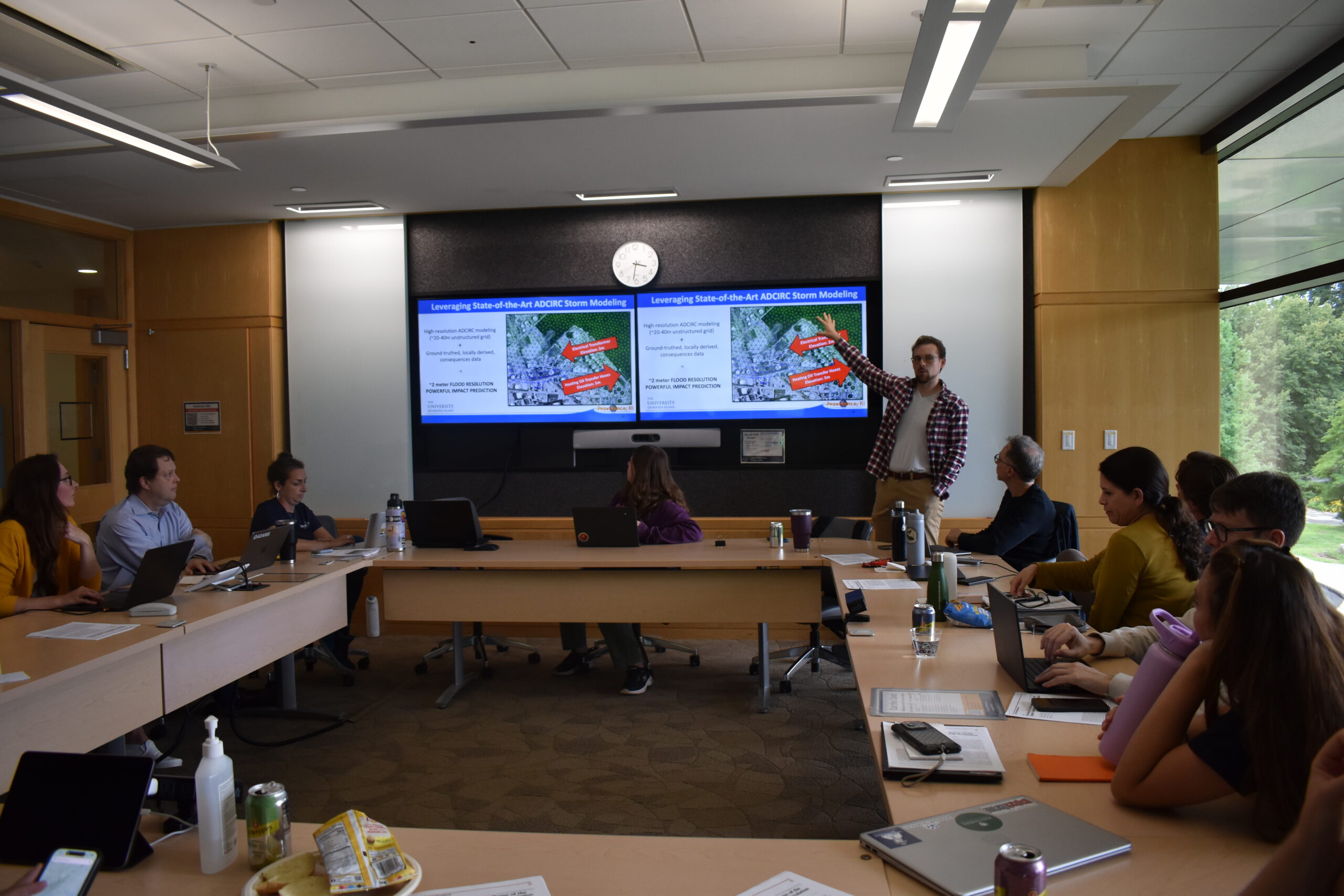
Journalists participating in a Metcalf Institute workshop explore the RI-CHAMP dashboard with University of Rhode Island researchers, discussing how to communicate coastal hazard information clearly before and during storms. Photo Nichole Nuttall
Connecting Hazard Tools With the People Who Use Them
The workshop reflects the broader mission of Rhode Island’s Natural Hazards Tools Collaborative, a partnership among Rhode Island Sea Grant, the University of Rhode Island, and Brown University. The Collaborative brings together decision-support tools designed to help communities prepare for storms, flooding, sea level rise, and other natural hazards.
One of those tools is RI-CHAMP, a storm simulation and real-time hazard forecasting system developed at the University of Rhode Island. The system provides early warning information to the Rhode Island Emergency Management Agency (RIEMA) and municipal emergency managers, helping predict hazards and assess potential impacts from coastal waves, storm surge, high winds, and flooding.
Beyond real-time forecasting, CHAMP lets emergency managers and planners simulate future storms and evaluate potential impacts to critical infrastructure, including electrical transformers, backup generators, and hazardous materials within port facilities. Originally developed to model coastal hazards, the system is now expanding to include inland communities and precipitation-driven flooding. Today, the Rhode Island Department of Environmental Management, the Rhode Island Department of Health, and Naval Station Newport also use CHAMP.
Putting Hazard Communication to the Test
During the workshop, journalists worked through realistic storm scenarios using information derived from CHAMP. They discussed what information helped them report confidently, where they needed more context to explain forecast uncertainty, and which hazard information could confuse the public.
Emergency managers, in turn, shared how they interpret the same information to support preparedness and response decisions, giving participants a behind-the-scenes look at how forecast information is translated into action before a storm.
“Emergency managers typically have robust public information programs, but often it’s journalists who know best how to reach their intended audience,” said Samuel Adams, emergency management director and adjunct professor of marine affairs at the University of Rhode Island. “Our immersion with the Metcalf Institute showed how emergency managers and journalists can work together to identify the information most important during and after a disaster event.”
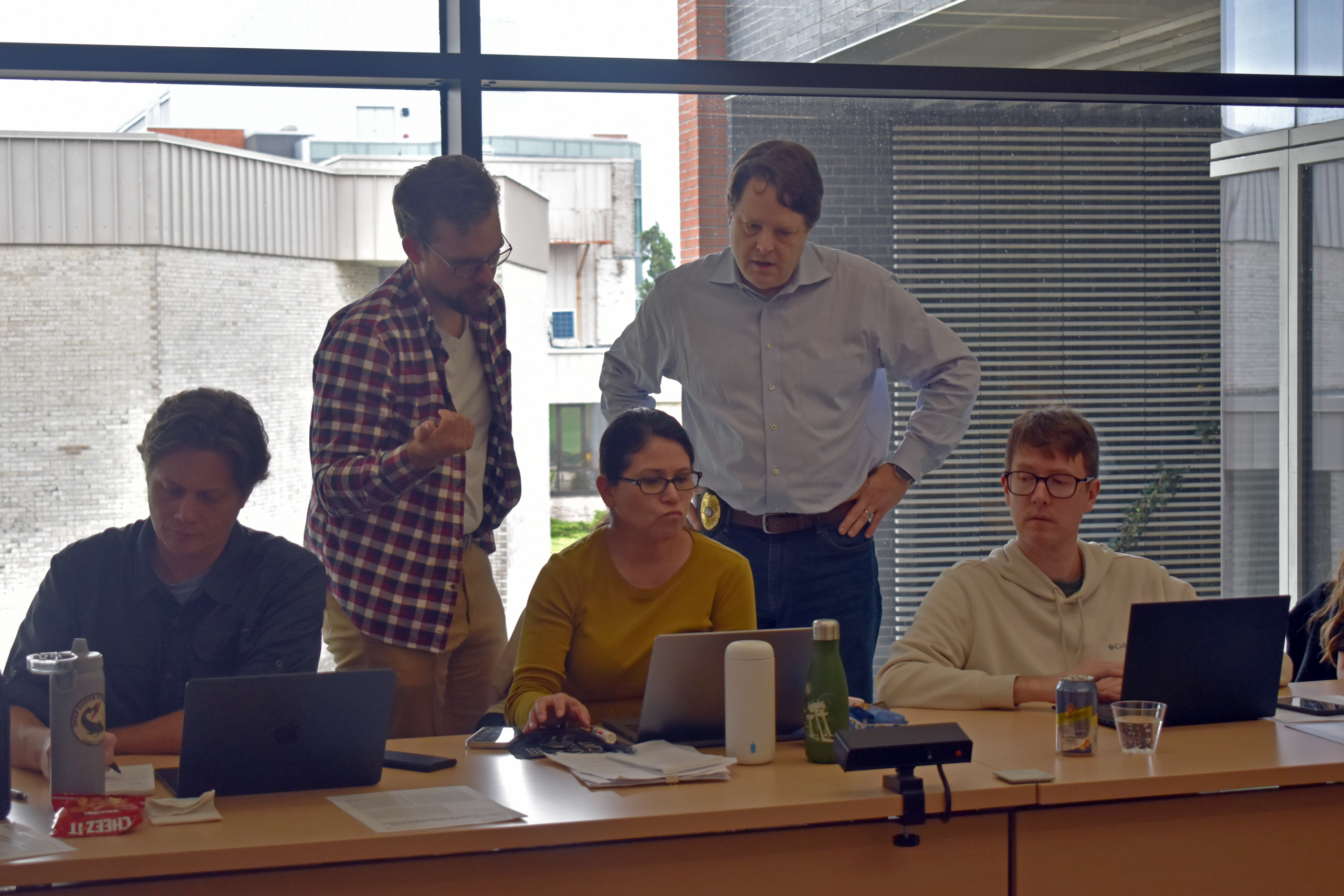
Sam Adams (right) and Jon Nelson, a URI research associate in marine affairs, help journalists access the RI-CHAMP dashboard and answer questions during the Metcalf Institute workshop. Photo Nichole Nuttall
Adams said building those relationships can help emergency managers better tailor the information they provide during press briefings and help journalists know what information to ask for.
“This is a new direction for decision support tools like CHAMP, but it seems to be a natural next step in the evolution of this technology,” he said.
The discussion reinforced that developing effective hazard tools involves more than building accurate models. It also requires engaging the people who rely on them—from emergency managers and planners to journalists and the public—to ensure information is communicated in ways that support informed decisions before, during, and after a storm.
By bringing those groups together before a storm occurs, the workshop provided an opportunity to identify where information is clear, where additional context is needed, and how tools like CHAMP can better support communication and decision-making when a storm threatens.
Learn more about CHAMP and other decision-support resources available through Rhode Island’s Natural Hazards Tools Collaborative.
Story by Meredith Haas, Rhode Island Sea Grant