
You could drive by the Middletown side of Newport’s Easton’s Pond without really noticing it’s there on the side of this busy roadway.
If you stop to look, however—as senior University of Rhode Island Landscape Architecture students did this past semester—you may see its potential as a community amenity, a place to view wildlife, relax, or walk easily to the local shops and restaurants that dot its shoreline.

Students tour the Easton’s Pond area with Middletown Conservation Commission Chairwoman Melissa Welch (at right in blue cap) in April. “It was such a privilege to work with these talented students who have given our community a wonderful gift—the opportunity to envision the Easton’s Pond and Green End Pond area as a place that brings our communities together in ways that protect and benefit the local environment,” Welch said.
While Middletown has some plans for the area, including converting an existing nearby school to a community center, the students were given free rein to use the location, along with Newport’s Braga Park and First Beach, as the basis for their senior capstone projects, creating designs to improve safety, accessibility, and resilience to stormwater flooding.
What they came up with were numerous creative concepts incorporating everything from boardwalks and pedestrian paths lined with native wildflowers to birdwatching groves, a farmer’s market, and a splash pad.
The 22 landscape architecture seniors and one environmental science master’s student in the class divided into teams of three to four and toured the area twice.
The adjacent map shows the four areas the teams focused on.


Landscape architecture capstone students host a community meeting at Middletown Town Hall to learn about residents’ preferences for and concerns about the study area.
They were guided by Melissa Welch, a Middletown resident and chair of the town’s conservation commission, and Hongbing Tang, assistant teaching professor of landscape architecture. They met with other residents and municipal leaders, including Ron Wolanski, Middletown’s director of planning and economic development, and Casey Tremper, Rhode Island Sea Grant coastal resilience specialist. They hosted a community meeting at Middletown Town Hall to gather ideas, and later presented their preliminary designs for feedback from the community leaders, Sea Grant staff, planning professionals, and landscape architecture faculty.
On May 5, they returned to town hall to present their final designs.
While some of the designs incorporated whimsical elements, such as colorfully painted pedestrian crossings, they were all rooted in proposing sustainable solutions to safeguard public water resources, improve water quality in the pond, better manage stormwater flooding, foster native habitat, and enhance safety, ADA accessibility, and the local economy.
“The students came up with some wonderfully creative and exciting ideas that can help us imagine the possibilities for enhancing this key area in ways that increase public access while also improving environmental resilience,” Welch said. “Their work contains a tremendous amount of technical detail as well as design techniques that can serve as a resource for developing actionable plans for the future.”

Students (L-R) Melanie Burek, Astou Dieng, Madison Holland, and Jesseca Martin present their design, highlighting the plants chosen for the area that are intended to help absorb stormwater.
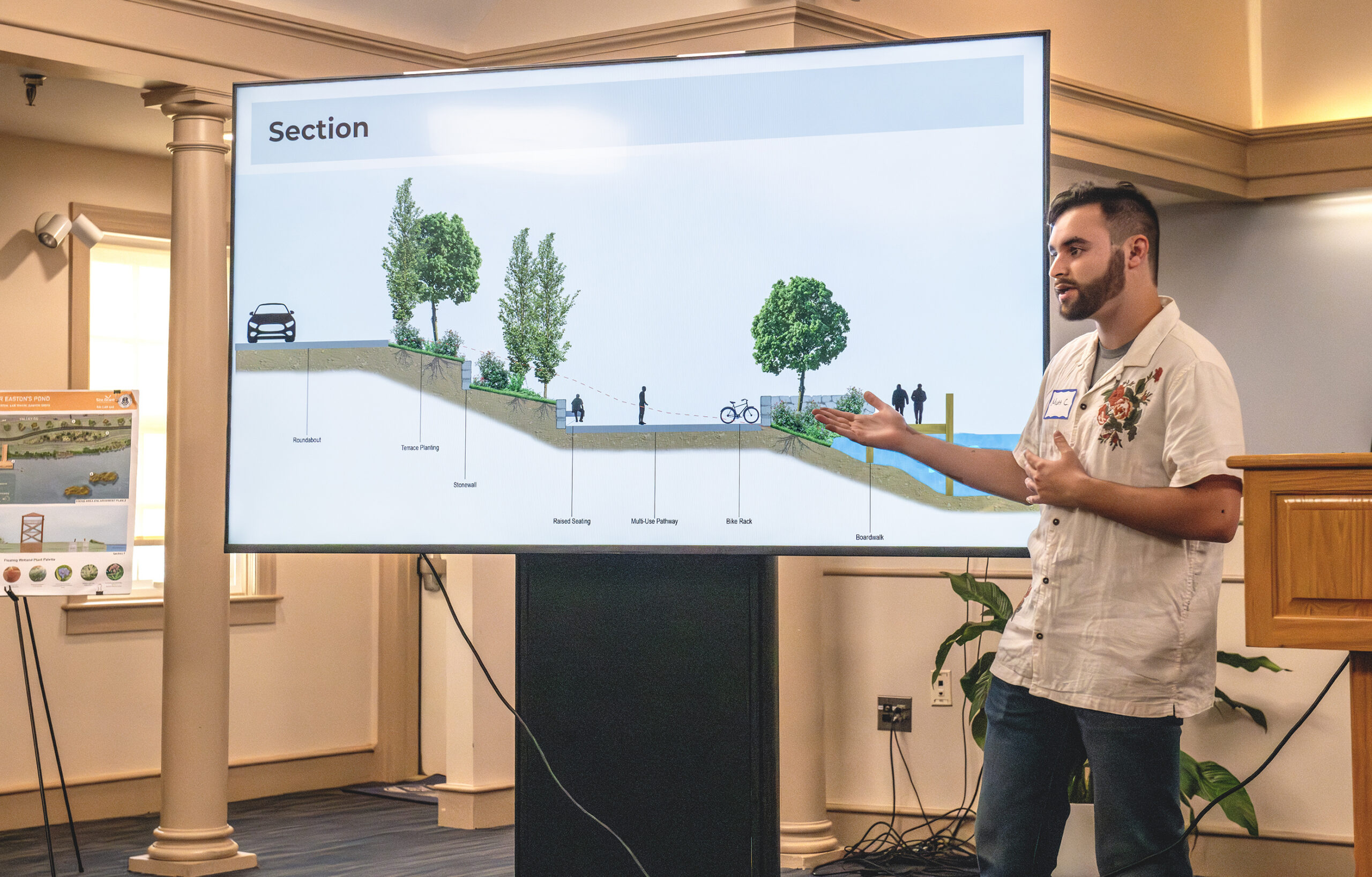
Matt Cipriano discusses this section of his team’s design, featuring terraced plantings for stormwater management, a multi-use path with a bike rack, and a pedestrian boardwalk over Easton’s Pond.
“The town is grateful for the effort put in by the students to learn about this area of Middletown and provide some truly inspiring ideas for providing improved access and amenities, while also enhancing resilience to the impacts of climate change,” Wolanski said.
“Teaching this capstone class has truly been a privilege, and I am incredibly proud of our students for the care, creativity, and rigor they brought to their work,” Tang said. “The students did an outstanding job reimagining the Easton’s Pond area through systematic thinking, making meaningful spatial and socioeconomic connections while striving to strengthen environmental resilience for critical public water resources.”
“My sincere thanks also go to our community partners. This capstone would not have been possible without all their guidance, help, and support!” she added.
Rhode Island Sea Grant sponsors the annual URI Landscape Architecture Senior Capstone along with URI and community partners. If your city or town would like to be considered for hosting a capstone in an upcoming spring semester, please contact Kim Ohnemus, Rhode Island Sea Grant workforce development coordinator, at kohnemus@uri.edu.