
New URI research offers a clearer picture of how pollution travels through the estuary.
Microplastics are everywhere in coastal waters—from tiny fibers shed by clothing to fragments of degraded packaging. But their abundance isn’t uniform across a place as dynamic as Narragansett Bay. New research from the University of Rhode Island is helping scientists understand where these particles accumulate, why hotspots form, and what that means for long-term coastal health.
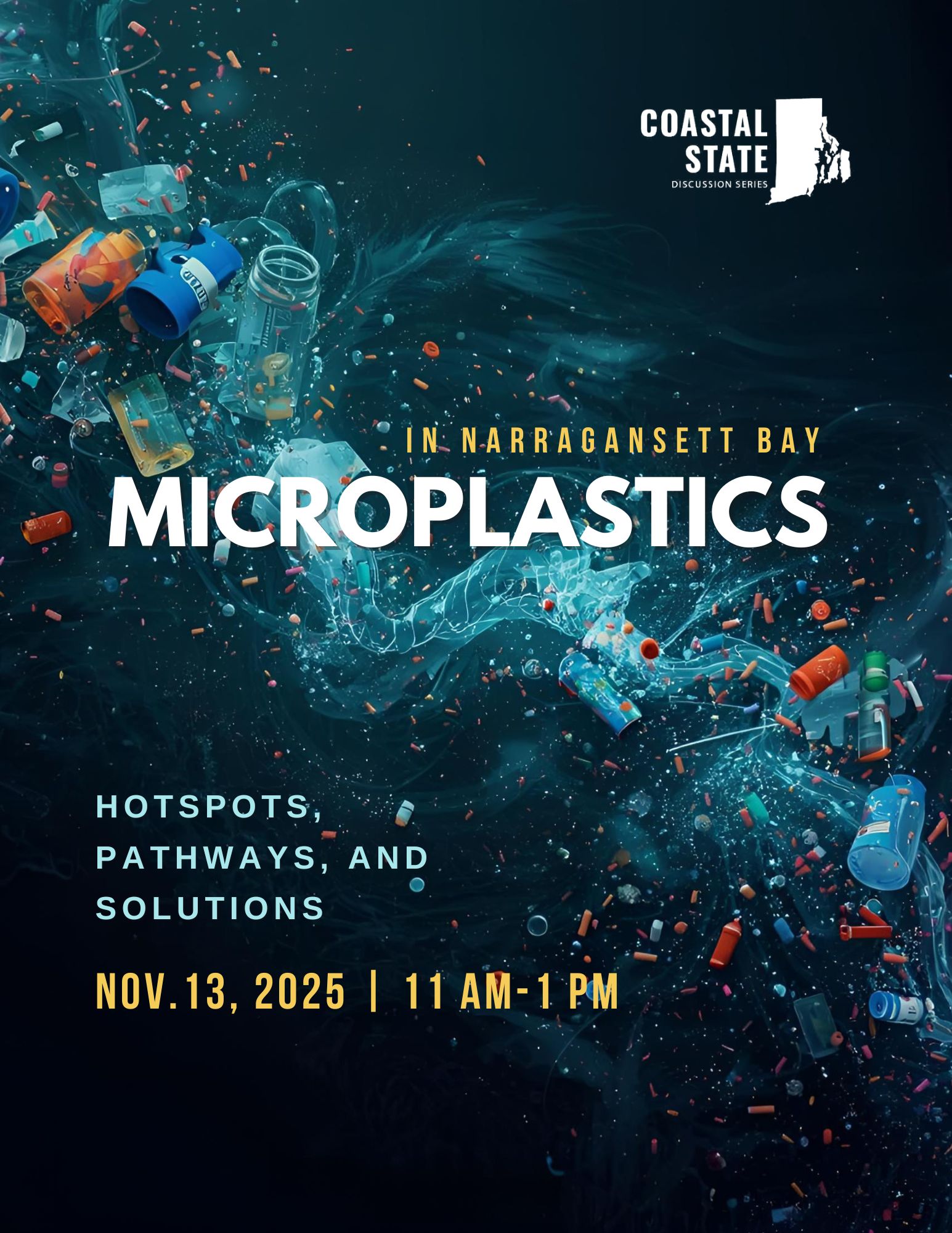
On November 13, Sarah Davis, a postdoctoral research fellow at URI, and Victoria Fulfer, a microplastics scientist from The 5 Gyres Institute, shared new findings as part of Rhode Island Sea Grant’s Coastal State Discussion Series. Their combined work paints the most detailed picture to date of how microplastics move through the estuary—and where they ultimately end up.
A Bay-Wide Pattern
Davis and her team sampled surface waters throughout the Bay during three seasons—winter, spring, and summer/fall—over two years. Each site was sampled twice, resulting in 72 unique trawls. The pattern that emerged showed microplastic concentrations are significantly lower in the southern reaches of Narragansett Bay compared to the more urbanized northern waters.
“Our results suggest that freshwater rivers flowing through urban areas are likely accumulating microplastics and then depositing them into the bay,” Davis said. Her project, supported by Rhode Island Sea Grant, is the first to examine surface transport of microplastics, revealing how seasonal wind patterns influence where particles concentrate.
This is partly driven by the fact that the southern Bay has fewer people living along those shorelines, which means less plastic enters the water through stormwater runoff, wastewater systems, and everyday use. It is also closer in proximity to the open ocean, which helps flush surface waters more regularly, preventing microplastics from lingering.
In contrast, the northern Bay receives freshwater from rivers that flow through some of Rhode Island’s most populated areas. Those rivers carry a steady stream of microplastics into the estuary, creating concentrations that far exceed those found in the south.
But the study also revealed more nuanced seasonal patterns. During wetter months, increased river flows and stormwater runoff carried more microplastics into the bay, which tended to accumulate in the northern areas during summer and fall, when prevailing southerly winds kept them there. In winter, however, shifting northerly winds helped transport these plastics farther south, with the highest concentrations observed in the Western Passage.
“We’re seeing the highest recoveries of microplastics after periods of high river flow,” says Davis, pointing to unusually heavy rains in the summer and fall that boosted runoff during the first year of sampling. “We’re seeing a relationship between increased river flow and elevated concentrations of plastics, and where those plastics go is closely related to wind.”
Marshes as Microplastic Sinks
Fulfer’s research, which revealed that nearly 1,000 tons of microplastics are stored in the upper two inches of the seafloor, supports the same north–south trend. Microplastic pollution in the Bay has been steadily increasing since the 1950s, but the impact is not evenly distributed.
“Microplastic accumulation in Narragansett Bay still varies through space from north to south, but that variation has persisted throughout the last 70 years,” Fulfer said. “It’s exponentially increasing over time, and it varies based on the environment type.”
One of the most striking findings concerns the role of coastal marshes. Fulfer’s team found that marshes near dense population centers trap 10 to 50 times more microplastics than nearby seafloor sediments. Even marshes on Conanicut Island—far from the urban core—had higher concentrations than adjacent bottom waters.
These results suggest that salt marshes may function as long-term storage sites for microplastic pollution, with implications for habitat health and restoration.
What this Means for Rhode Island
Microplastics—defined as plastic particles smaller than 5 millimeters—have become a defining pollutant of modern oceans. Scientists have now found them in wildlife, drinking water, and even the human body, but their health effects remain uncertain.
What Davis and Fulfer’s work makes clear is that microplastics in Narragansett Bay are overwhelmingly land-based, carried downstream via rivers, storm drains, and wastewater systems—not simply litter from local shorelines.
“Targeted efforts to reduce urban runoff into freshwater rivers and to improve wastewater management during high river flow periods could be really effective in mitigating microplastic inputs into the bay,” Davis said.
This research adds important nuance to the growing body of knowledge on microplastics in coastal environments. For Rhode Island, it highlights both the challenges and opportunities ahead: protecting estuarine habitats that act as pollution filters, strengthening monitoring efforts, and reducing upstream sources before they reach the water.
Narragansett Bay’s health is shaped by the communities and watersheds that feed it. Understanding how microplastics move through this system is a crucial step toward managing pollution at its source and ensuring a cleaner, more resilient Bay for generations to come.
–Meredith Haas, RISG SciComm & Digital Media Manager