One month into his NOAA Sea Grant Knauss Fellowship, University of Rhode Island and Roger Williams University School of Law graduate Samuel Filiaggi is already finding himself at the center of the nation’s marine policy conversations. Working in NOAA’s Office of Legislative and Intergovernmental Affairs, Filiaggi is helping connect scientific expertise with federal decision-making. As he settles into his new role in Washington, D.C., each day offers a new opportunity to see how science, policy, and public service intersect.
As an undergraduate at the University of Rhode Island, Filiaggi enrolled as a marine biology major. But after just one semester, he realized the questions that interested him most weren’t being answered in marine biology.
“We’re doing this research. We have this knowledge. But how do we apply it to people’s lives? How can we use this to create better decisions and better policies?” Filiaggi recalled wondering.
That realization led him to pursue marine affairs at URI, where he earned his bachelor’s degree and continued on to the joint-degree graduate program that offers a J.D. from Roger Williams University School of Law and a Master of Marine Affairs from URI. Looking back, he says his academic career gave him the opportunity to combine science, law, and policy in a way that matched both his interests and career goals.
Those experiences helped prepare Filiaggi for one of the nation’s most competitive marine policy opportunities: the NOAA Sea Grant Knauss Fellowship. The year-long fellowship places early-career professionals in legislative and executive branch offices throughout Washington, D.C., where they contribute scientific and technical expertise to federal policy decisions affecting marine, coastal, and Great Lakes resources.
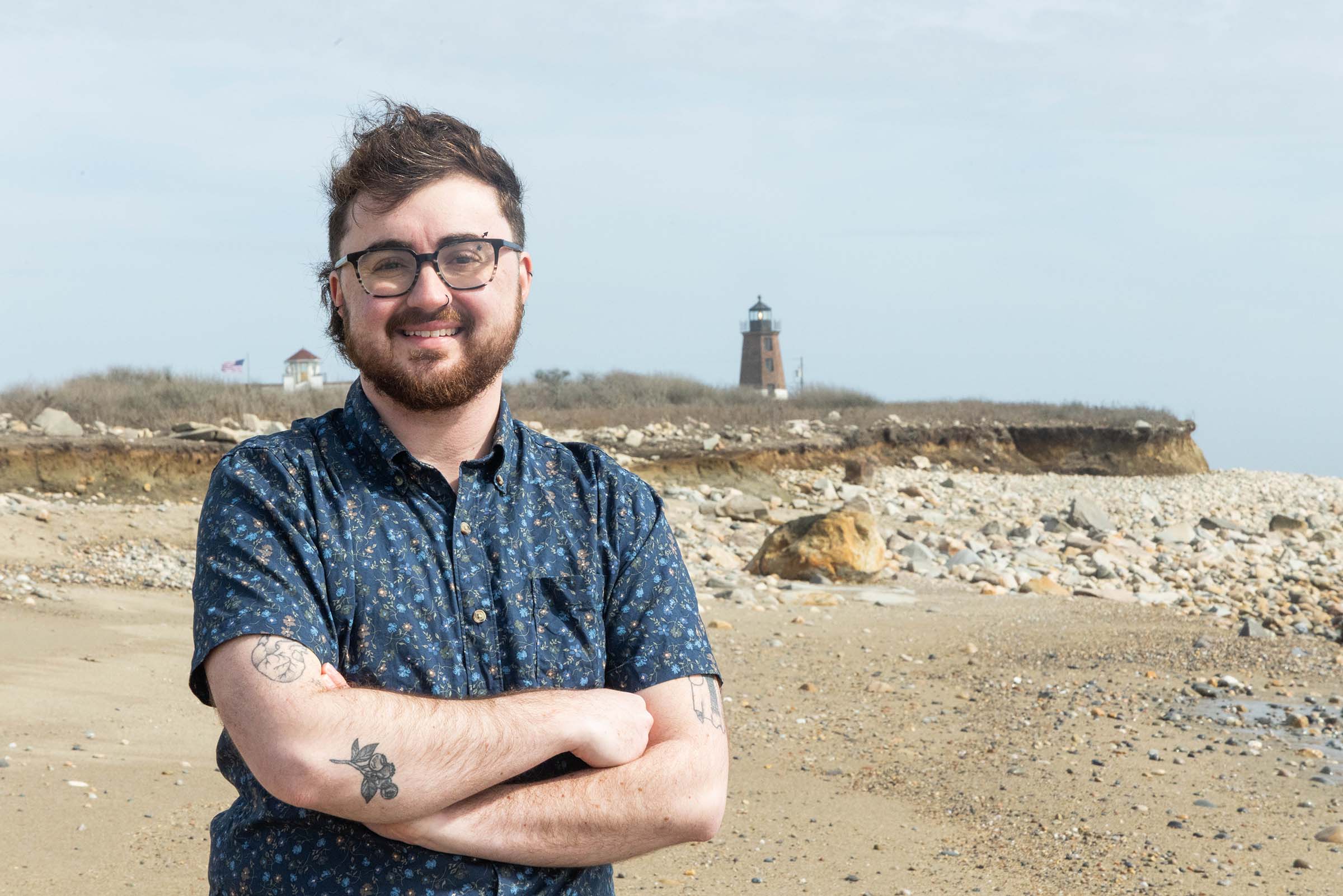
A graduate of URI’s joint-degree program with Roger Williams University School of Law, Samuel Filiaggi ’19 M.M.A. ’25 is now in Washington, D.C., for the 2026 Sea Grant Knauss Fellowship. (Photo / Manal Murangi)
Filiaggi was selected to serve in NOAA Headquarters’ Office of Legislative and Intergovernmental Affairs, which serves as the connection between Congress and NOAA. The office works directly with members of Congress, congressional staff, and NOAA’s line offices, coordinating requests for information, arranging briefings, and helping communicate the agency’s work to lawmakers.
Within the office, Filiaggi supports the National Weather Service and NOAA’s Office of Marine and Aviation Operations (OMAO). OMAO oversees much of the agency’s data collection efforts, including ocean buoys, research vessels, aircraft, and the Hurricane Hunter missions that fly directly into storms to collect critical weather data. Together, these offices provide essential information that helps NOAA monitor weather, oceans, and changing environmental conditions. For Filiaggi, no two days are the same. His work ranges from coordinating meetings and congressional briefings to collaborating with scientists across NOAA and translating complex scientific information into language policymakers can easily understand.
One of the first major projects Filiaggi worked on was helping prepare a NOAA scientist and expert to testify before the House Committee on Science, Space, and Technology during a potential congressional hearing on space weather. The hearing will focus on a topic many people associate with the aurora borealis, but one with far-reaching impacts. Solar storms originating from the sun, can disrupt satellites, communication systems, GPS technology, power grids, and other critical infrastructure, making space weather an important area of research and disaster preparedness.
“My office has been helping prepare one of NOAA’s witnesses [who will be] testifying before the House Committee on Science, Space, and Technology,” Filiaggi said. “Space weather is beautiful to experience, but it’s also potentially really dangerous and something that’s important to prepare for because of the effects solar storms can have on our infrastructure, our phones, the lights, and the power grid.”
Solar storms, also known as the aurora borealis, originating from the sun, can disrupt satellites, communication systems, GPS technology, power grids, and other critical infrastructure, making space weather an important area of research and disaster preparedness. Photo: URI Bay Campus in Narragansett by Amirali Momeni – second place in the URI Research & Scholarship photo contest.
This experience gave Filiaggi an inside look at the relationship between science and policymaking. Through mock hearings, planning meetings, and discussions with scientists and congressional affairs staff, he saw firsthand how important it is to communicate complex research in a way that lawmakers and the public can understand.
“What makes a good witness isn’t necessarily the person who knows the most—it’s the person who can communicate that knowledge the best,” Filiaggi said. “Even if you have the world’s leading expert on space weather, if that person isn’t good at translating that knowledge and connecting it to people’s lives, they’re not going to be effective.”
For Filiaggi, that’s what the fellowship is ultimately about: helping scientific knowledge reach the people making decisions that affect communities across the country.
“Ultimately, the goal is getting NOAA to the people through our representatives,” he said.
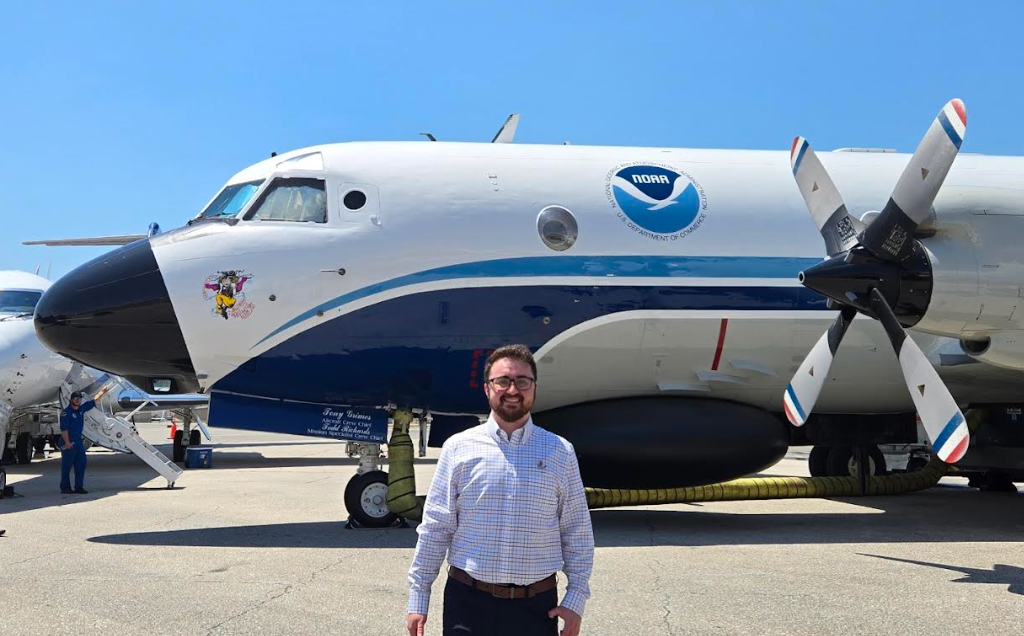
A photo of Sam at a Hurricane Awareness event at DCA hosted by NOAA, where he accompanied Congressional staff on tours of Hurricane Hunter planes last month.
Looking beyond the fellowship, Filiaggi is interested in a career where science, law, and policy come together to address environmental challenges. Whether that path leads to government or nonprofit work, he hopes to continue leveraging environmental law and science to help solve coastal and marine issues.
For students interested in following a similar path, his advice is simple:
“The Knauss Fellowship is about developing your own narrative. Take as many opportunities as you can.”
– Isabella Carmichael, Rhode Island Sea Grant