
Over 1,000 tons of microplastics have accumulated in the top five centimeters of the seafloor in Narragansett Bay. This puts seabed-dwelling organisms—and the predators that rely on them—at growing risk of exposure.
With support from Rhode Island Sea Grant, University of Rhode Island researchers developed a technique to measure how crabs handle microplastics consumed in prey, offering new insights into the ways coastal species could encounter, ingest, and eliminate plastic pollution.
By emphasizing environmentally realistic experimental conditions in the lab, researchers identified that crabs can rapidly egest microplastics consumed through prey at the particle sizes and quantities investigated by the study.
Jonah crab is an emerging New England fishery valued at more than $20 million annually. Yet basic information on the species’ life history—including growth, mortality, and contaminant exposure—remains limited, complicating fisheries management. To better understand how crabs handle microplastics, researchers developed a novel lab technique to better understand this in controlled experiments.
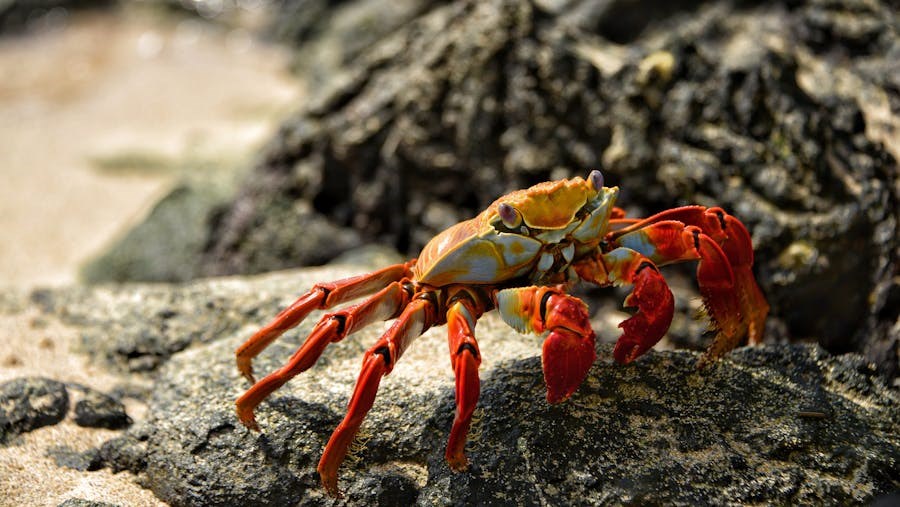
“We developed an improved lab method for consistently dosing food sources used as prey in microplastics trophic-transfer studies that maintains environmental realism in particle dose, characteristics, and prey handling,” says lead author Sarah Davis. “This allowed us to quantify and track how microplastics are handled and processed by by thiscrab under short- and longer-term predation scenarios.”
The study, published in the Journal of Hazardous Materials, is titled “Novel microplastic dosing approach of shellfish prey reveals highly efficient egestion rates by predatory crabs under environmentally realistic feeding scenarios.” It grew directly out of Rhode Island Sea Grant–funded microplastics research in Narragansett Bay and nearby coastal waters.
A More Realistic Approach to Microplastics Research
Most laboratory studies expose marine animals to plastics suspended in water or mixed into food in ways that don’t reflect how microplastics actually enter marine diets. To address this gap, the URI team developed a lab-based method to inject known amounts of polyester microfibers—the same fibers shed from sources that include clothing and fishing gear—directly into a prey food source, using an oyster as an example. This allowed crabs to handle food the way they naturally do: cracking hard parts, ripping tissue, and scattering fragments. That messy feeding behavior matters, the study found.
“Our lab results show crabs can rapidly egest plastics consumed via prey, and that messy predation can release microplastics into the water to be taken up by respiratory tissues,” Davis says.
Using their new dosing approach, the researchers asked two main questions:
- How much plastic stays inside a crab after a single meal containing microplastics?
- Do these build up after repeated meals?
They found that crabs ingested roughly 70% of the microplastics contained in a single dosed prey item, but the vast majority ( ~ 99%) were quickly egested within 24 hours.
Around 1% of particles ended up in the gills, likely taken up from the surrounding water during “messy” feeding, when fibers are released into the surrounding water. Even after repeated consumption, the researchers observed little evidence of microplastics accumulating in the stomachs or gills, and very little movement of particles into internal organs such as the hepatopancreas, hemolymph, or reproductive tissues. For the particle types and sizes tested, the crabs appeared efficient at clearing microplastics from their bodies in the short term.
But Wild Crabs Tell a More Complicated Story
Despite these controlled-lab results, the researchers found that field-collected crabs contained more microplastics in their gills and reproductive tissues than in their stomachs or digestive organs—a pattern that diverged from the laboratory outcomes. These discrepancies echo a growing body of evidence showing that wild organisms encounter and retain plastics differently than animals in controlled settings, notes co-author Coleen Suckling.
“We identified discrepancies in microplastics present in these same tissues between controlled lab experiments and field-collected organisms – a phenomenon other researchers have recently been observing, too.”
Possible explanations include longer, chronic exposure in the wild; variation in particle size, shape, and polymer types; weathering or biofilms that affect particle behavior; and interactions with other pollutants or stressors, highlighting a need for further research to better understand this.
Together, these findings suggest that species biology, feeding behavior, and ecological context—not just trophic level—shape microplastic exposure and presence. A predator high in the food web may not accumulate plastics if it can efficiently egest what it ingests.
Why it Matters
By offering a more realistic method to deliver microplastics to prey and trace their movement through predators, researchers can better evaluate plastics in the marine environment and ecosystem. This has implications across multiple sectors, such as organisations involved in waste, environmental, and ecosystem management
For Davis, the work underscores the value of strategic research investment. Rhode Island Sea Grant funding “allowed us to look further into microplastics pollution,” she says—support that has now led to multiple peer-reviewed publications advancing understanding of microplastics in Narragansett Bay and beyond.
Read Full Study
Novel microplastic dosing approach of shellfish prey reveals highly efficient egestion rates by predatory crabs under environmentally realistic feeding scenarios
–Meredith Haas, RISG SciComm & Digital Media Manager